What Is a Walk On?
There's no official definition, but most park-goers agree on one thing: it means a minimal wait. We looked at Magic Kingdom's 2025 data to see how often they actually happen, and found a second category that might matter just as much.

What Counts as a Walk On?
Ask ten theme park fans and you'll get ten answers. Disney doesn't publish an official definition. Neither does Universal. The term lives in the community, and it's always been a little fuzzy.
But most people land in roughly the same place: a walk-on is when you show up and get on the ride with little to no wait. Maybe you walk straight through the queue without stopping. Maybe you pause for one train cycle. Either way, you're on in minutes, not in an hour.
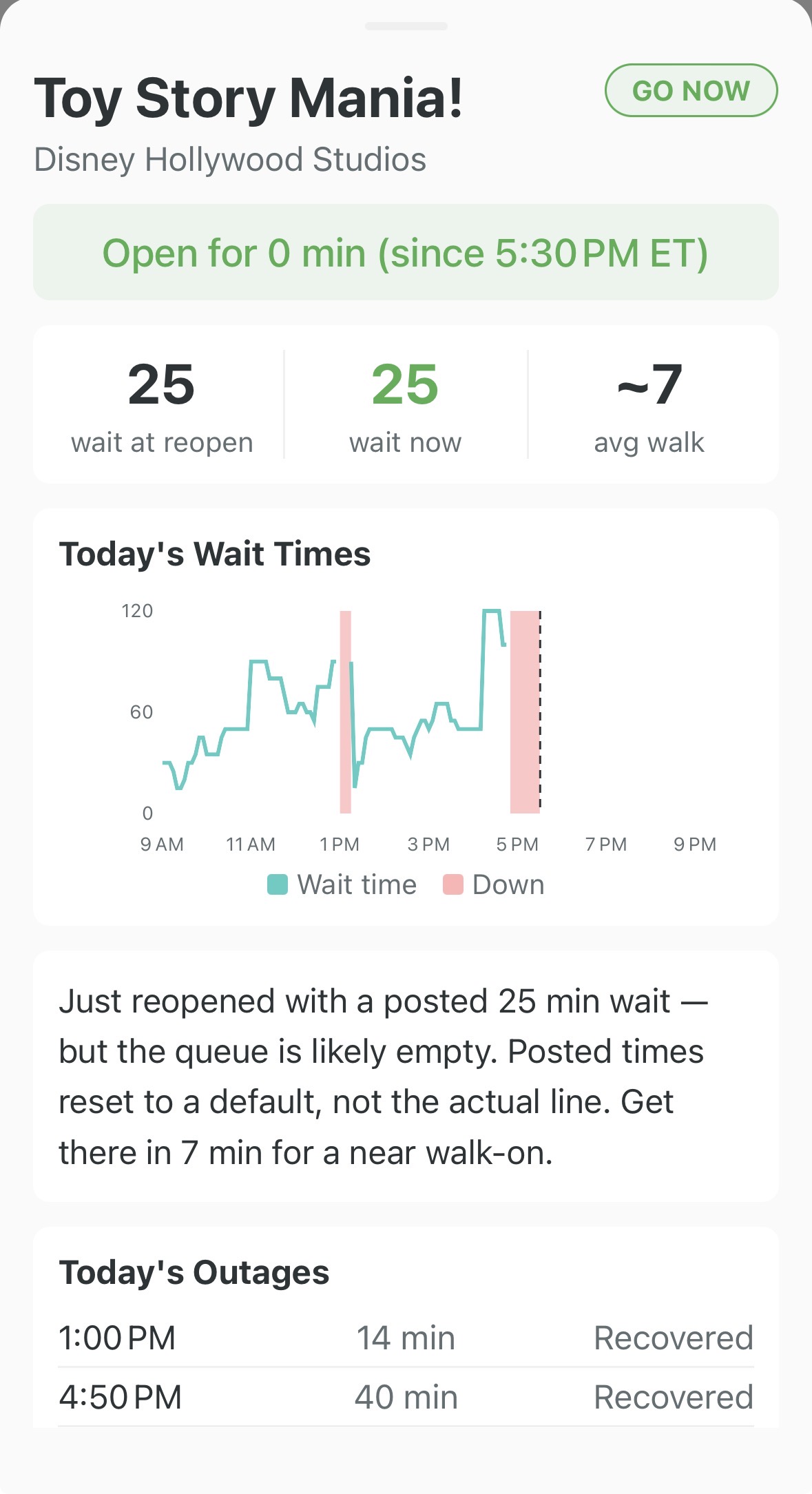
For this analysis, we define walk-ons by the posted wait time when a ride comes back from a breakdown:
- Under 10 minutes: A true walk-on. You're basically walking straight onto the ride.
- Under 15 minutes: Close to a walk-on. Maybe one or two trains ahead of you.
- Under 20 minutes: A short wait by any standard, especially if the ride normally has a 60+ minute line.
Walk-Ons Used to Be Everywhere
If you went to Disney in the '90s or early 2000s, you remember a different park. You could ride Space Mountain twice in a row. You could wander into Pirates of the Caribbean at 2 PM on a Saturday and barely slow down. Walk-ons weren't a strategy. They were just what happened when you picked the right moment.
That world is gone.
Parks are packed now, and not just during spring break or Christmas week. Year-round crowding has become the norm. Attendance keeps climbing, ticket prices keep rising, and somehow the parks just keep getting more crowded. A "slow day" at Magic Kingdom in 2025 still means 45-minute waits for headliners.
So where do walk-ons come from in the modern era? They come from breakdowns.
How Often Does Magic Kingdom Get a Walk-On?
We tracked every ride breakdown at Magic Kingdom in 2025 (every time a ride went down and came back) and measured the posted wait time at the moment it reopened. Here's what we found:
(under 10 min wait)
Four true walk-ons per day. At the most crowded park in America. That's not a lot, but it's not zero either. And if you're getting a push notification the moment one of those windows opens, you don't need many. You just need to be close enough to act on one.
The 15- and 20-minute thresholds matter too. At a park where headliners regularly post 90-minute waits, a 15-minute wait is a gift. Eight times a day, a ride comes back from a breakdown and the line is genuinely short.
| Threshold | Per Day | What It Feels Like |
|---|---|---|
| Under 10 min | 4.0 | True walk-on. Straight to the ride vehicle. |
| Under 15 min | 6.3 | One or two trains ahead of you. Barely a wait. |
| Under 20 min | 8.0 | A short wait when everyone else is waiting an hour. |
The Other Opportunity: Dips
Walk-ons get all the attention, but there's a second category that can save you just as much time over the course of a day. We call them dips.
A dip is when a ride comes back from a breakdown and the wait isn't technically short, but it's significantly shorter than what's normal for that time of day. Maybe Space Mountain usually has a 75-minute wait at 2 PM, and it comes back at 45. That's not a walk-on. But it's 30 minutes of your life you just got back.
The wait is short, period.
Under 10–20 minutes posted wait. You're walking on or close to it, regardless of what the ride normally runs. These are the ones that feel magical.
The wait is shorter than usual.
The posted wait might be 30 or 40 minutes, but the ride normally runs 60+ at that time of day. You're saving real time, even if you're not walking straight on.
At Magic Kingdom in 2025, dips happened regularly:
15+ minutes vs. normal
30+ minutes vs. normal
That 0.35 might look small, but think about it differently: roughly every three days, a ride comes back from a breakdown with a wait time 30+ minutes below what it would normally be. On a week-long Disney trip, that's two or three chances to shave half an hour off a single ride. And you don't need to stalk the app for it. You just need a notification.
Why Dips Matter
Walk-ons are the headline. But dips might actually save you more time overall.
Here's why: true walk-ons tend to happen on rides that already have moderate waits. If a ride normally runs 20 minutes and comes back at 5, you saved 15 minutes. Nice, but not life-changing.
Dips, on the other hand, tend to happen on the headliners, the rides with the longest normal waits. When Seven Dwarfs Mine Train comes back from a breakdown with a 35-minute wait instead of its usual 80, that's 45 minutes saved on a single ride. It's not a walk-on by any definition, but it might be the best deal in the park at that moment.
The takeaway: Don't fixate on zero-minute waits. A ride that comes back 30 minutes below its daily average is worth knowing about, especially on the headliners where normal waits are brutal.
How WalkOnAlerts Catches Both
WalkOnAlerts doesn't just watch for walk-ons. It watches for both categories:
- Walk-on alerts: A ride reopens with a genuinely short wait. Get there now.
- Dip alerts: A ride reopens with a wait well below its daily average. Still worth acting on, especially for headliners where even a "short" wait is 30+ minutes.
Both types come with context: how far you are from the ride, how fast the line is likely to rebuild, and whether it's worth walking over. Because a walk-on on the other side of the park isn't worth much if the window closes before you get there.
Walk-ons and dips. We catch both.
Get WalkOnAlerts