Not Every “Breakdown” Is a Breakdown
That massive spike of ride closures at 9 AM? Most aren't mechanical failures. They're opening delays, and they follow completely different patterns. WalkOnAlerts now knows the difference.

The 9 AM Problem
When you look at ride breakdowns by hour of day across all the theme parks we track, one bar jumps off the chart:
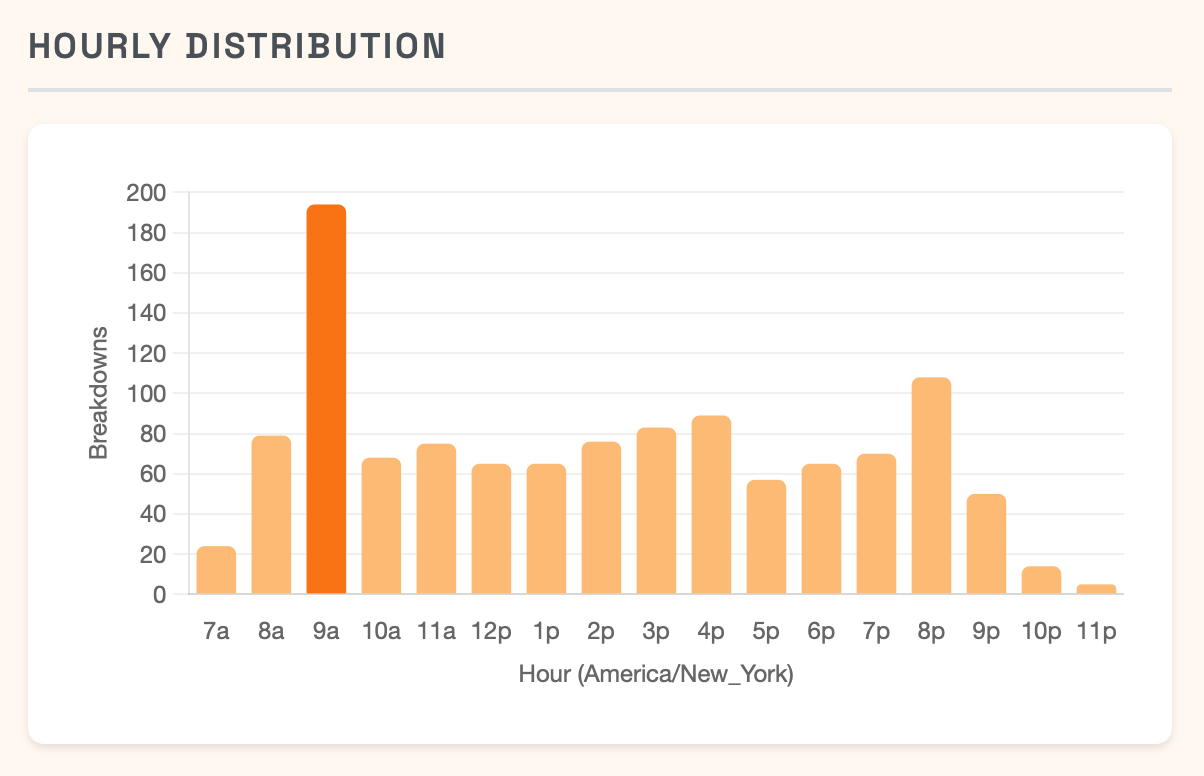
Hourly breakdown distribution across 11 Disney and Universal parks • The 9 AM spike is nearly 3x any other hour
The 9 AM bar is nearly triple the height of every other hour. That's suspicious. Rides don't suddenly become three times more failure-prone the moment the gates open.
So what's actually happening?
Opening Delays Are Not Breakdowns
Most of those 9 AM “breakdowns” are actually opening delays: rides that simply aren't ready when the park opens. It happens for all kinds of routine reasons: morning inspections ran long, a vehicle needs a calibration check, the crew is still cycling empty trains. It's normal operations, not a mechanical failure.
But until now, we treated them the same way. If a ride was DOWN at park open, our Stay or Go feature would show you breakdown predictions built from mid-day failure data: “75% of breakdowns at this time last over an hour.”
That's misleading. A ride that routinely opens 20 minutes late has nothing in common with a ride that breaks down at 2 PM. The duration distributions are different. The causes are different. And the right advice for a guest standing outside the entrance is completely different.
Opening delay: Slinky Dog Dash isn't running yet at 9:05 AM. It opens late about a third of mornings. When it does open, it's usually within 20 minutes. This is normal.
Actual breakdown: Slinky Dog Dash stops running at 2:15 PM after operating all morning. A sensor tripped. This is a mechanical failure with a different recovery pattern.
How We Tell Them Apart
For every ride we track, we now analyze its opening behavior over the past several months: How often does it open on time? How often is it late? When it's late, how long does the delay typically last?
Each ride gets its own adaptive window based on its historical pattern. If a ride has never taken longer than 45 minutes to open, we know that a closure at 9 AM is likely an opening delay, but if it's still down an hour later, something else is going on, and we switch to our normal breakdown analysis.
We also check for edge cases. If a ride was operating during Early Entry (extra magic hours) and then went DOWN before regular park hours, that's a breakdown, not an opening delay, because the ride was running and something failed. And rides with fewer than 20 days of tracking data don't get opening delay detection at all, because we don't have enough history to be confident.
What This Means for You at 9 AM
When you open Stay or Go for a ride that's down at park opening, you'll now see one of two things:
Generic breakdown predictions
“75% of breakdowns at this time last over an hour,” based on mid-day mechanical failures. Scary, and usually wrong for opening delays.
Opening delay context
“This ride opens late 33% of mornings. Usually open by 9:15 AM,” based on this specific ride's actual opening history. Calm, accurate, actionable.
If a ride is genuinely having a bad morning and exceeds its historical window, Stay or Go automatically transitions to the full breakdown analysis. You always get the right context for the situation.
Better Predictions Across the Board
Separating opening delays from breakdowns doesn't just improve the 9 AM experience. It makes every breakdown prediction more accurate.
Our survival curve models (the engine behind every Stay or Go recommendation) were trained on all historical breakdown events. Thousands of opening delays were mixed in with the real mechanical failures, skewing the predictions. Opening delays tend to be shorter and more predictable than real breakdowns, which made the model too optimistic about how quickly a mid-day failure would resolve.
By filtering opening delays out of the training data, our breakdown predictions become more honest. When a ride breaks down at 2 PM, the model now draws exclusively from actual mid-day mechanical failures, with no morning delays diluting the numbers.
The result is sharper, more trustworthy recommendations whether you're standing outside a ride at 9 AM or caught in a breakdown queue at 3 PM.
Smarter Notifications at Park Open
Previously, if you had alerts on for a ride that routinely opens late, you'd get a misleading breakdown notification every morning: “75% of breakdowns at this time last over an hour.” That's not useful when the ride just needs 15 minutes to finish morning checks.
Now, WalkOnAlerts recognizes the opening delay and gives you the real context: “Opens late 33% of mornings. Usually open by 9:15 AM.” And here's the part most guests miss: when a delayed ride finally opens, the rope-drop crowd has already scattered to other attractions. Lines are short. WalkOnAlerts will notify you when a delayed ride is likely to open based on its historical pattern, the same way it notifies you when a broken ride is likely to reopen. Every notification is about a walk-on opportunity.
Smarter at 9 AM. Smarter all day.
Opening delay detection is live in WalkOnAlerts, along with per-ride breakdown predictions, walk-on window alerts, and the Stay or Go advisor.
Get WalkOnAlerts